
In his first direct comments on relations with India, China's new leader Xi Jinping has assured Prime Minister Manmohan Singh that his country would pay great importance to developing bilateral ties as their cooperation has brought substantial benefits to both sides. "

Spinners of both sides will have a significant role to play considering that Jasprit Bumrah and Shaheen Shah Afridi are the only specialist pacers who will be seen in action in Sunday's match.
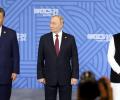
China has expressed its support for Russia's initiative to revive the Russia-India-China (RIC) troika, emphasizing its importance for regional and global security and stability.
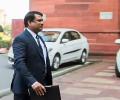
India has summoned Bangladesh's acting High Commissioner, expressing concern over recent statements by Bangladesh authorities that "portray India negatively" and hold New Delhi responsible for internal governance issues. The Ministry of External Affairs said India desires a positive relationship with Bangladesh, but these statements "vitiate the atmosphere" and are "responsible for persistent negativity." The statement comes after Bangladesh's interim government accused deposed Prime Minister Sheikh Hasina of "provocative" statements from India that led to unrest in Bangladesh.

India's economy could reach $20.7 trillion in terms of purchasing power parity (PPP) by 2030 and may emerge as the second-largest economy by 2038 with $34.2 trillion GDP, an EY report said on Wednesday. The report also said that with appropriate countermeasures, India can limit the adverse impact of higher US tariffs on selected Indian imports to about 10 basis points of real GDP growth.

The 25 per cent US tariffs, plus a penalty for Russian imports, could dent India's GDP growth by 30 basis points in the current fiscal, but the higher duty is unlikely to significantly affect India's domestic demand-driven economy, Barclays said on Thursday. If the 25 per cent tariff, announced by US President Donald Trump on Wednesday, is implemented from August 1, the effective average US import tariff on Indian goods will rise to 20.6 per cent in trade-weighted terms, as per Barclays estimates.
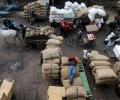
Deloitte on Thursday projected economic growth at 6.5-6.7 per cent for the current fiscal, as tax incentives provided in the Budget are expected to push domestic demand amid an uncertain global trade environment. Deloitte estimated India's GDP growth at 6.3-6.5 per cent for FY25 and said that the economic outlook for FY26 hinges on a delicate balance between evolving trade relations and government efforts to boost domestic consumer demand.
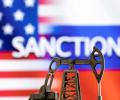
Russia has a "special mechanism" to confront any challenge arising out of the US slapping punitive measures against India for its procurement of Russian crude oil, Russian charge d'affaires Roman Babushkin said on Wednesday.

The formulations in the declaration in reference to terrorism is going to be to our "satisfaction", Dammu Ravi, secretary (economic relations) in the external affairs ministry said on Monday.

In his meeting with Prime Minister Narendra Modi on the sidelines of the 16th BRICS Summit in the Russian city of Kazan, Xi said that China-India relations are essentially a question of how the two large developing countries and neighbours, each with a 1.4-billion-strong population, treat each other, it added.
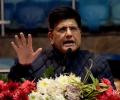
Commerce and Industry Minister Piyush Goyal will lead a team of senior Indian officials to Washington starting May 16 for discussions with their US counterparts on the proposed bilateral trade agreement (BTA), an official said on Tuesday. Goyal is expected to hold meetings with US Trade Representative (USTR) Jamieson Greer and US Commerce Secretary Howard Lutnick during his visit.
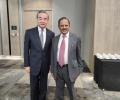
National Security Advisor Ajit Doval held a meeting with top Chinese diplomat Wang Yi during which he emphasised the need for continuing efforts to restore peace and tranquillity in the border areas to remove the 'impediments' to normalcy in bilateral relations.

The Jaishankar-Wang talks came amid the dragging border row in eastern Ladakh that entered its fifth year in May.
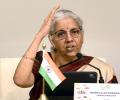
Issues related to the proposed free trade agreement (FTA) and bilateral investment treaty between India and the UK are expected to figure during the three-day visit of Finance Minister Nirmala Sitharaman to London from April 8-10, official sources said. The minister will attend a host of meetings, including the India-United Kingdom Economic and Financial Dialogue, in London.
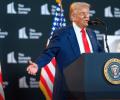
On August 7, the US president announced doubling tariffs on Indian goods to 50 percent for India's purchases of Russian crude oil, but gave a 21-day window to negotiate an agreement.

'Just as we cannot surrender the interests of our farmers and dairy industry, Trump is also looking for markets for the produce of the farmers in the Midwest, which are his support base.'
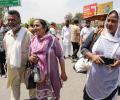
India has revoked all visas issued to Pakistani nationals effective April 27, advised Indian nationals in Pakistan to return home, and suspended visa services to Pakistani nationals. The move comes in retaliation to the Pahalgam terror attack that killed 26 people and alleged cross-border links to the attack. This escalation follows India's previous actions against Pakistan, including expelling Pakistani military attaches, suspending the Indus Water Treaty, and shutting down the Attari land-transit post.
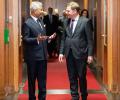
External Affairs Minister S Jaishankar has asserted that India has zero tolerance for terrorism and will never give in to nuclear blackmail, emphasizing that New Delhi will deal with Pakistan purely bilaterally. He made these remarks during a joint press conference with his German counterpart in Berlin, where he also highlighted the importance of the strategic partnership between India and Germany, emphasizing the need for a free trade agreement between the two nations.
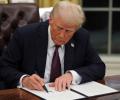
Dr Jaishankar is expected to discuss the dates for the fifth Quad leaders' summit in India later this year.
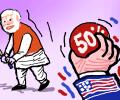
'Things may get much worse before they get better,' predicts Ajay Chhibber.
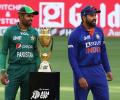
Pakistan government gave clearance to the country's senior men's team to travel to India for the 2023 World Cup, ending months of uncertainty over their participation in the showpiece.
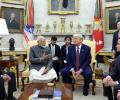
Trade, defence cooperation and regional strategy had long formed the backbone of India-US ties, but the latest rift shows how quickly those pillars can be shaken by personal grievances and political optics.

National Security Advisor Ajit Doval on Monday emphasised the need to counter terrorism in all its forms for overall regional peace and stability during a meeting with Chinese Foreign Minister Wang Yi in Beijing.
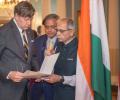
A statement issued by State Department Spokesperson Tammy Bruce said Landau "reaffirmed the United States' strong support of India in the fight against terrorism and the strategic partnership between the two countries".
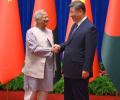
Bangladesh's Chief Adviser Muhammad Yunus has called upon China to expand its economic influence in Bangladesh, controversially mentioning that India's northeastern states being landlocked could present an opportunity. Yunus, who recently visited China and met with President Xi Jinping, highlighted Bangladesh's role as the "only guardian of the ocean " in the region, suggesting it could be a pathway for Chinese economic expansion. This statement has sparked debate, with Sanjeev Sanyal, a member of Prime Minister Narendra Modi's economic advisory council, questioning the relevance of India's landlocked states in Yunus' appeal to China. Yunus, however, emphasized the importance of a strong friendship with China, viewing it as a counterbalance to India. During his visit, Yunus signed nine agreements with Beijing and secured USD 2.1 billion in investments, loans, and grants from the Chinese government and companies.
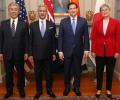
Increasing cooperation in critical minerals will top Prime Minister Modi's agenda during his discussions with leaders of Ghana, Argentinia, Brazil and Namibia.

His comments came hours after External Affairs Minister S Jaishankar arrived in the Pakistani capital to attend the Council of Heads of Government (CHG) summit of the Shanghai Cooperation Organisation.

Trading sentiment in the stock market this week will be guided by quarterly earning announcements from blue-chips such as Infosys and Bajaj Finance, the outcome of India-US trade talks and global cues, analysts said. Markets may on Monday react to the quarterly results of three heavyweights - Reliance Industries, HDFC Bank and ICICI Bank, an expert said.
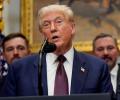
"India is not only buying massive amounts of Russian Oil, they are then, for much of the Oil purchased, selling it on the Open Market for big profits," Trump said in a social media post on Monday.
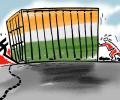
The USA's steep 50 per cent tariffs on Indian goods entering America will severely impact exports and job creation in labour-intensive export sectors such as shrimp, apparel, leather and gems and jewellery. Exporters said that the imposition of a 25 per cent penalty on India over and above the 25 per cent tariffs move will disrupt the flow of Indian goods to its largest export market.

Chinese Foreign Minister Wang Yi has expressed readiness to join hands with India's National Security Advisor Ajit Doval to "properly handle" issues related to the situation on the ground in the border areas, amid the protracted border row in eastern Ladakh.
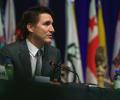
India on Friday said it hopes to rebuild ties with Canada based on 'mutual trust and sensitivity', blaming the downturn in the relations to the 'licence' that was given to the 'extremist and secessionist elements' in that country.

Brendan Lynch, the assistant US trade representative for South and Central Asia, will pay a five-day visit to India beginning Tuesday, days before US President Donald Trump's tit-for-tat tariff kicks in. The senior US trade official is expected to hold talks with Commerce Minister Piyush Goyal besides meeting a number of senior Indian officials.

In a statement after a meeting between Trump and Pakistan Army chief Asim Munir at the White House on Wednesday, the Inter-Services Public Relations -- the media wing of the Pakistan Army -- said they also discussed joint counterterrorism efforts.
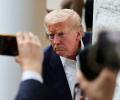
'We are a responsible nation, and would prefer to deal with sensitive issues with the maturity they deserve rather than take to social media.'

'If Washington has to balance Chinese power, she will have to turn to the third biggest power in the world which is India.' 'The United States and India will have to work together in order to keep Chinese ambitions in check.'
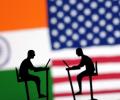
A team of senior officials from India will again visit Washington this month to hold discussions with their US counterparts on the proposed bilateral trade agreement (BTA), government sources said on Thursday. To give impetus to the talks, India's chief negotiator Rajesh Agrawal, special secretary in the Department of Commerce, and Assistant US Trade Representative for South and Central Asia Brendan Lynch had last month held three-day talks in Washington.

'While the President has been critical of India, he has gone out of his way to compliment PM Modi. They have an incredible relationship.'

Indian External Affairs Minister S Jaishankar and his Canadian counterpart Anita Anand held their first phone conversation, focusing on strengthening bilateral economic ties and advancing shared priorities. The call comes amid efforts to repair relations between the two countries, which had been strained under the previous Canadian government. Both ministers expressed their commitment to improving ties and working together on areas of mutual interest. The conversation follows a period of tensions stemming from allegations of Indian involvement in the killing of a Sikh activist on Canadian soil.

'Geopolitically and diplomatically it's a very difficult situation for India.'
